Pots and Pans Sets: What to Check Before You Buy
Choose a pots and pans set by matching its pieces, material and cooktop compatibility to the meals you make and the space you have. A larger piece count matters only if you will use what is included.
On this page (10 sections)
- What should you check first in a pots and pans set?
- Which pieces do you actually need?
- Which cookware material fits your cooking?
- Will the set work on your stove?
- How do lids, handles and oven limits affect the choice?
- How should you set up and care for a new set?
- What mistakes should you avoid when buying cookware?
- Which set styles are worth comparing?
- When is buying a set better than choosing individual pans?
- How do you make the final choice?
Choose a pots and pans set by matching its pieces, material and cooktop compatibility to your meals and kitchen. A large piece count does not guarantee that the set includes the pans you reach for most.
Start with the jobs you do every week: boiling pasta, cooking rice, frying eggs, sautéing vegetables or making soup. Then check whether the set has the right shapes and sizes, works on your stove and fits your cabinets.
This guide covers what to compare, how each style suits a different cook, and the habits that help you get more from a new set. For the main material trade-offs, read our guide to the best material for pots and pans.
What should you check first in a pots and pans set?
Check useful pieces, material, cooktop fit and storage before comparing extras. Those choices determine whether a set works in your kitchen day after day.
| Check | What to compare | Why it matters |
|---|---|---|
| Pieces | Pan sizes, pot sizes, lids and inserts | The total can include lids and accessories |
| Material | Stainless steel, clad, hard-anodized or ceramic nonstick | Each suits different cooking and cleaning habits |
| Stove fit | Gas, electric, ceramic glass or induction | Cookware compatibility varies by set |
| Storage | Cabinet and drawer space | Larger sets need somewhere to live |
| Care | Hand washing, dishwasher use and coating care | Maintenance affects daily convenience |
| Heat limits | Oven-safe temperature and lid limit | Limits matter for recipes that finish in the oven |
Make a short list of meals you cook often and the cookware each one needs. That list may show that a compact set with a skillet and two saucepans is more useful than a collection with specialty pieces you rarely use.
Also consider what you already own. If you have a good stockpot or skillet, avoid buying a set that duplicates it unless the other pieces make the collection worthwhile.
Which pieces do you actually need?
Choose pieces based on your regular cooking, not the number printed on the box. A lid, steamer insert or cooking utensil may count toward the total without adding another pot or pan.
Many kitchens use a skillet for eggs and quick meals, saucepans for grains and sauces, and a larger pot for pasta or soup. A sauté pan, griddle, steamer or Dutch oven earns space when it matches a task you do often.
How many pots and pans do you need?
The number depends on how many dishes you cook at once and how often you wash cookware between meals. Write down the pieces you use in a typical week, then add only the cookware that fills a clear gap.
Our guide to how many pots and pans you need offers a practical way to count them. If you are setting up a new home, our first-apartment cookware guide focuses on a smaller starter collection.
Think about your usual portions, too. A small saucepan may handle oatmeal or one serving of sauce, while a larger saucepan gives you room for pasta sauce or side dishes for several people.
What does the piece count include?
Piece counts can include lids, inserts and utensils, so compare the actual contents rather than treating the number as a count of pots and pans. Check which lids fit which cookware and whether accessories take up space you would rather use for pans.
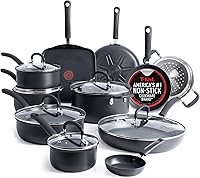
The T-fal set includes saucepans, frypans, a griddle, sauté pan, Dutch oven, steamer and an egg frypan. The GreenPan set includes saucepans, a stockpot, frying pans, a sauté pan and utensils.
A set with fewer pieces can still cover more of your cooking if its sizes are right. Count the actual pots and pans first, then decide whether the extras are useful enough to affect your choice.
Which cookware material fits your cooking?
Choose the material that matches what you cook, how you clean and how you want the pans to perform. Stainless steel, clad construction, hard-anodized aluminum and ceramic nonstick each bring different trade-offs.
| Material or construction | Consider it if | Check before buying |
|---|---|---|
| Stainless steel | You want cookware for browning and sautéing | Whether heat-spreading material is in the base or throughout the pan |
| Clad stainless steel | You want layered construction across the pan | Exact construction and cooktop compatibility |
| Hard-anodized aluminum with nonstick | Easy food release and a broad assortment matter | Care instructions, coating and stove limits |
| Ceramic nonstick | You prefer a ceramic-coated cooking surface | Care guidance, oven limits and utensil habits |
Is stainless steel or clad cookware right for you?
Stainless steel can suit cooks who brown food and want cookware for a range of stovetop tasks. Construction matters: an encapsulated base and fully clad sides describe different ways heat-spreading material is built into a pan.
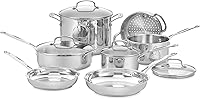
The Cuisinart Chef's Classic set has stainless steel cookware with an aluminum-encapsulated base. The Tramontina Signature set is tri-ply clad, with an aluminum core, and includes saucepans, frying pans, a stockpot and a pasta strainer insert.
If layered construction is a priority, see what clad cookware means and compare tri-ply stainless steel cookware sets. Our guide to what 18/10 stainless steel means in cookware explains a common stainless steel label.
Stainless steel can require a change in cooking technique if you are used to nonstick. Preheat gradually, use a suitable amount of cooking fat when needed, and avoid moving delicate food before it releases from the pan.
Skip stainless steel if you mainly want effortless release for eggs and prefer not to adjust your cooking routine. A nonstick skillet paired with stainless steel pots can be a practical alternative to choosing one material for every piece.
Would a hard-anodized nonstick set fit your routine?
Hard-anodized nonstick can suit cooks who want easy food release and several pan shapes in one collection. Compare the care directions and heat limits before buying, because coating and handle requirements vary.
The T-fal Ultimate Hard Anodized set includes frypans, a griddle, sauté pan, Dutch oven and steamer. Its Thermo-Spot indicator turns red when the pan is properly preheated.
The set excludes induction cooktops, so skip it if induction compatibility is essential. It also calls for hand washing, making it a weaker fit if your main priority is dishwasher cleanup.
For a broader shortlist, browse hard-anodized pots and pans sets. If you choose coated cookware, use utensils and cleaning tools suited to its surface.
Would ceramic nonstick make sense for you?
Ceramic nonstick can suit cooks who want a coated surface and prefer a PFAS-free option. Check the stated stove compatibility, oven limit and care guidance before making it your everyday set.
The GreenPan x Bobby Flay set uses a diamond-infused ceramic nonstick coating and includes two frying pans, a sauté pan and cooking utensils. It works on gas, electric and induction cooktops.
Skip it if you need an oven limit above 392°F or want stainless steel cookware. For a closer comparison of surface types, see our ceramic versus nonstick cookware guide.
A coating is not a reason to use high heat by default. Follow the care instructions for the set, avoid unnecessary overheating, and use tools that won't damage the cooking surface.
Will the set work on your stove?
Check the specific set’s stated cooktop compatibility, especially if you cook on induction or a glass-top stove. A set that suits one kitchen may not work on another.
| Set | Cooktop compatibility |
|---|---|
| Cuisinart Chef's Classic | Gas, glass ceramic and induction |
| T-fal Ultimate Hard Anodized | Stovetops except induction |
| GreenPan x Bobby Flay | Gas, electric and induction |
| Tramontina Signature Tri-Ply Clad | Induction, gas, electric and ceramic glass |
If you use induction, rule out the T-fal set and compare the other sets by their pieces, construction and care needs. Do not rely only on a broad material name, since compatibility can differ by set.
For a glass-top stove, choose compatible cookware and handle it carefully to avoid dragging heavy pans across the surface. Our guide to pots and pans for a glass-top stove covers fit and handling.
Check the base size against your burner, too. A pan that is much wider than the heating area may cook unevenly, while an unstable or poorly fitting base can be awkward to handle.
How do lids, handles and oven limits affect the choice?
Compare lid materials, handle design and oven limits with the way you cook. These details help determine whether a set suits covered simmering, stovetop-to-oven recipes and your preferred grip.
Glass lids let you see food without lifting the cover, while stainless steel lids keep the lid opaque. Handles also vary in material and design, so consider how you grip a pan and how much clearance you have around the burners.
Oven limits can apply separately to pans and lids. T-fal specifies an oven limit of 400°F for its cookware and 350°F for its lids; Cuisinart and Tramontina describe their sets as oven-safe up to 500°F.
GreenPan specifies an oven limit of 392°F. Check the care guidance for the exact set before putting a lid or pan in the oven, since their limits may differ.
If you often finish a dish in the oven, choose a set whose limit accommodates your recipes. If your cooking stays on the stovetop, prioritize useful pan sizes, stove compatibility and easy handling.
How should you set up and care for a new set?
Set up a new collection by sorting the pieces, matching lids and reading the care directions before the first meal. A little planning helps you find the right pan quickly and avoid damage from unsuitable storage or utensils.
Start by checking each pot and pan against the jobs on your meal list. Put the most-used pieces within easy reach, then store specialty items and accessories where they will not block everyday cookware.
Keep lids together in a rack, drawer divider or cabinet space where they will not slide onto pan surfaces. If you stack pans, use a protective layer between them, especially when the cooking surface is coated.
Follow the care method for the particular set. Cuisinart describes its stainless steel set as dishwasher-safe, Tramontina lists dishwasher-safe care, and T-fal specifies hand washing; GreenPan's product information highlights dishwasher use, but its care guidance should still be checked before you make it a routine.
For any nonstick surface, avoid rough scouring pads and sharp tools unless the care instructions allow them. Let cookware cool before washing, since sudden temperature changes can stress a pan.
What mistakes should you avoid when buying cookware?
Avoid choosing a set by piece count, appearance or brand name alone. Those shortcuts can leave you with the wrong sizes, incompatible cookware or pieces that are difficult to store.
Common mistakes include:
- Counting lids and utensils as though they were extra pans.
- Buying a large set before measuring cabinet and drawer space.
- Forgetting to check induction compatibility.
- Assuming every piece and lid shares the same oven limit.
- Choosing a coating without considering cleaning and utensil habits.
- Buying a set that duplicates pans you already use.
- Assuming stainless steel construction is the same across every set.
The fix is simple: compare the included pieces against your meal list, confirm the stove fit and check the storage space. Then weigh the care routine and temperature limits against how you cook.
Which set styles are worth comparing?
Compare sets by the features that solve your specific cooking needs. These four examples suit different priorities, from a wide variety of cookware shapes to layered stainless steel.
T-fal Ultimate Hard Anodized 17-Piece Set
The T-fal set suits cooks who want an extensive nonstick assortment with a griddle, Dutch oven and steamer. Its indicator helps show when a pan is properly preheated.
Skip it if your stove uses induction or if hand washing does not fit your routine. Its oven limit is 400°F for pans and 350°F for lids.
Tramontina Signature Tri-Ply Clad 11-Piece Set
The Tramontina set suits cooks who want tri-ply clad stainless steel and a pasta strainer insert. It works across induction, gas, electric and ceramic glass cooktops.
Skip it if you prefer easy-release nonstick cooking or want glass lids that let you see food while it cooks. The set is oven-safe up to 500°F.
Cuisinart Chef's Classic 11-Piece Stainless Set
The Cuisinart set suits cooks who want stainless steel pieces for everyday stovetop meals, including three saucepans, two skillets, an 8 qt stockpot and a steamer insert. Its aluminum-encapsulated base spreads heat through the base.
The set includes glass covers for its saucepans and stockpot, plus a saucepan with a helper handle. Skip it if you specifically want fully clad construction throughout each pan.
GreenPan x Bobby Flay 13-Piece Ceramic Set
The GreenPan set suits cooks who want ceramic nonstick cookware with utensils included. It covers a useful spread of pots and pans and works on induction, gas and electric cooktops.
Skip it if your recipes need a higher oven limit than 392°F or you prefer uncoated stainless steel. The included turner, slotted spoon and spatula may be useful if you are building a kitchen from scratch.
When is buying a set better than choosing individual pans?
A set can be a good fit when most of its pieces fill real needs and you have room to store them. Buying individual pans may suit you better when you need only a few pieces or want different materials for different jobs.
Before choosing a set, compare its useful cookware count with a short list of individual pans you would buy. Include lids and accessories in the comparison, but do not count them as pots or pans.
A mixed collection can make sense: stainless steel saucepans for simmering, plus a nonstick skillet for eggs. That approach can reduce unused pieces, though individual buying takes more time and may leave you matching lids and storage one pan at a time.
For a fuller breakdown, read are cookware sets worth it or should you buy pieces?. If you are buying for a new home, the first-apartment cookware guide can help you keep the first collection focused.
How do you make the final choice?
The right pots and pans set is the one whose useful pieces, material and stove fit match your actual cooking routine. Choose a set only after checking what you already own, measuring storage and deciding which care habits you can maintain.
Choose Cuisinart if you want stainless steel with an aluminum-encapsulated base and a broad everyday assortment. Choose Tramontina if tri-ply clad construction and an included pasta insert matter most.
Choose T-fal for its large nonstick assortment if you do not cook on induction and are comfortable hand washing. Choose GreenPan if ceramic nonstick, PFAS-free coating and included utensils fit your priorities.
If none of the four matches your needs, use the same checklist to compare other options in our guide to the best pots and pans sets. The best choice is the one you can store, use and care for without paying for pieces that stay untouched.
Frequently asked questions
What should I look for in a pots and pans set?
Check that the set has the pan sizes and shapes you use, works on your cooktop, and fits your storage space. Then compare materials, coatings, lids, handles, care needs and oven limits.
Count useful cookware pieces rather than relying on the set's headline piece total.
How many pieces should a cookware set have?
A useful set can have fewer pieces than a large collection if it covers your regular meals. Count each pan, pot, lid and accessory separately, then check how many are cookware you will use.
Our guide to how many pots and pans you need can help you make that list.
Is stainless steel or nonstick better for a cookware set?
Stainless steel and nonstick suit different cooking habits. Stainless steel can suit browning and stovetop-to-oven cooking, while nonstick can make delicate foods and cleanup easier.
Compare care instructions and oven limits, then see our material guide for more detail.
Can I use any cookware set on an induction stove?
No. Check the exact set's stated cooktop compatibility before buying; some cookware sets exclude induction.
If you have a glass-top stove, consider pan base shape and weight.
Our glass-top stove cookware guide covers fit and handling.
Are cookware sets worth buying?
A cookware set can be worthwhile when most included pieces match your cooking routine and storage space. Buying individual pans may make more sense if you need only a few sizes or want different materials for different tasks.
Compare both options in our cookware set versus individual pieces guide.