What Does 18/10 Stainless Steel Mean in Cookware?
18/10 stainless steel contains about 18% chromium and 10% nickel. Those alloy amounts help explain its resistance to rust and corrosion, but they don't tell you how evenly a pan heats.
On this page (7 sections)
18/10 stainless steel contains about 18% chromium and 10% nickel. Those alloy amounts help explain its resistance to rust and corrosion, but they don't tell you how evenly a pan heats.
The grade is one part of a cookware choice. Construction matters too: an 18/10 cooking surface may sit over a bonded base or be part of a layered pan, and those designs can heat differently.
What does 18/10 stainless steel mean?
The numbers refer to approximate percentages of chromium and nickel in the steel alloy. The rest is mostly iron, along with small amounts of other elements that vary by grade and manufacturer.
Chromium forms a thin protective layer on the steel surface when exposed to oxygen. Nickel also supports corrosion resistance and helps give many stainless steels their bright finish.
The numbers describe composition, not quality by themselves. They don't specify the pan's thickness, whether it contains an aluminum core, or whether the full body is clad.
For a wider comparison of cookware materials, see what is the best material for pots and pans.
Does 18/10 tell you how a pan heats?
No. The alloy grade doesn't tell you how quickly or evenly a pan heats.
That depends more on the cookware's base or layers, their materials, and how they are joined.
A stainless cooking surface is durable, but stainless steel alone does not spread heat as quickly as materials such as aluminum. Some pans add an aluminum layer in the base to help distribute heat.
A bonded base usually places a heat-conducting layer beneath the cooking surface. Clad cookware extends layers through the sides as well, though designs vary; what clad cookware means explains tri-ply and 5-ply construction.
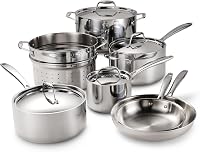
Ciwete describes this set as tri-ply with an impact-bonded base. That means the steel grade and the heat-spreading base are separate details to check when comparing pans.
Is 18/10 better than 18/8?
18/10 has about 2 percentage points more nickel than 18/8, while both contain about 18% chromium. That difference alone doesn't make one pan a better choice for every kitchen.
Both grades are used in stainless cookware. The exact alloy and how the pan is made matter, but the grade label does not describe its heat core, construction, or compatibility with a particular stovetop.
Tramontina Tempo uses 18/8 stainless steel for its cooking surface and an impact-bonded aluminum core in its tri-ply base. Its set includes a 10 in frying pan, 2 qt and 3 qt saucepans with lids, and a 5 qt Dutch oven with lid.
The set is described as induction-ready, oven-safe up to 350°F, and dishwasher-safe. Compare those details with your needs instead of choosing by the 18/10 label alone.
For another view of the trade-offs, read aluminum vs stainless steel cookware.
Does 18/10 stainless steel cookware work on induction?
The 18/10 label by itself doesn't confirm induction compatibility. Induction works with a magnetic base, so look for a clear compatibility statement or test the cookware with a magnet.
Some stainless cookware combines a nonmagnetic cooking surface with a magnetic outer layer. That layered design can make a pan induction-compatible even though the surface alloy alone doesn't answer the question.
Check compatibility for the exact set and each piece you plan to use. A manufacturer may state that a set works on induction, as KOCH Systeme CS does for its 17-piece cookware set.
KOCH Systeme CS describes the set as oven-safe up to 500°F. The 17 pieces include three saucepans, three frying pans, a deep sauté pan, two stockpots, a steamer insert, a spatula, and a ladle.
Is 18/10 stainless steel cookware nonstick?
No. 18/10 stainless steel is not a nonstick coating.
Food can stick to stainless steel, especially if the pan is too cool, too hot, or crowded.
Preheat the pan at a moderate setting, then add oil and let it warm before adding food. Give ingredients time to brown and release before trying to turn them.
If you want cookware with a coating designed for easier release, compare it with stainless in our guide to the best material for pots and pans. The right choice depends on what you cook and how you want to care for the pan.
CAROTE's set uses 18/8 stainless steel, full tri-ply construction, and detachable handles. It is a different example of how material grade and pan design work together.
CAROTE says the set works on all cooktops, including induction, and is oven-safe to 600°F. It includes a frying pan, saucepans, a sauté pan, detachable handles, utensils, and protectors.
What should you check besides the 18/10 label?
Check the pan's construction, stove compatibility, pieces, and care instructions. Those details help you judge whether the cookware suits your cooking habits and kitchen.
- Construction: Look for a bonded base or full cladding, and identify any heat-conducting core.
- Stove fit: Confirm compatibility with your cooktop, especially if you use induction or a glass top.
- Set contents: Check the pan sizes and types you will use instead of relying on the piece count.
- Care: Read the temperature limits and cleaning guidance for the cookware and its lids.
A label such as “18/10” is useful information, but it is not a complete cookware specification. Our tri-ply stainless steel cookware guide explains what to look for in layered sets.
How should you choose 18/10 stainless steel cookware?
Choose by construction and fit first, then use the alloy grade as one helpful detail. If you want stainless cookware, check whether the pan has a heat-spreading core, works on your stove, and includes the sizes you need.
The Ciwete and KOCH Systeme CS sets have 18/10 steel and aluminum-core bases. Tramontina Tempo and CAROTE use 18/8 steel, with different tri-ply designs and set formats.
If your main question is how the layers affect cooking, start with what clad cookware means. If you're comparing materials more broadly, use the cookware material guide to narrow your choice.
Frequently asked questions
What does 18/10 mean on stainless steel cookware?
18/10 describes the alloy's approximate composition: 18% chromium and 10% nickel. Chromium helps stainless steel resist corrosion, while nickel contributes to its corrosion resistance and appearance.
The numbers don't tell you whether a pan has an aluminum core or how its layers are arranged.
Is 18/10 stainless steel good for cooking?
It can be a useful material for cookware because it resists corrosion and does not add a coating to the cooking surface. Cooking performance also depends on the pan's shape and heat-conducting layers.
Check whether it has a bonded base or full cladding, and match the pan to your stove.
Is 18/10 better than 18/8 stainless steel?
Both grades contain about 18% chromium; 18/10 has about 10% nickel, while 18/8 has about 8%. That difference alone doesn't show which pan will cook better.
Construction, thickness, handle design, and the cooking surface all matter when you choose cookware.
Does 18/10 stainless steel cookware work on induction?
The 18/10 label alone doesn't confirm induction compatibility. Induction needs a magnetic cooking base, so check the cookware's stated compatibility or test the base with a magnet.
Many stainless pans use a magnetic outer layer even when other layers serve different roles.