Hard-Anodized vs Stainless Steel Cookware Sets: Which Is Better? (November 2026)
Choose hard-anodized cookware for a nonstick cooking surface, or stainless steel for browning and deglazing. For hard anodized vs stainless steel cookware, start with your cooktop, the foods you cook most and how you want to care for your pans.
On this page (6 sections)
Choose hard-anodized cookware for a nonstick cooking surface, or stainless steel for browning and deglazing. Hard anodized vs stainless steel cookware also differs in induction compatibility, cleaning and the amount of attention food release may need.
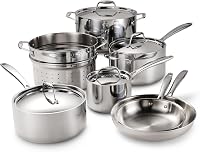
The hard-anodized sets in this guide pair aluminum bodies with nonstick interiors. The Cuisinart MultiClad Pro instead has an aluminum core between stainless steel layers, with tri-ply construction extending from the base up the sides.
If you're comparing materials more broadly, see our guide to the best material for pots and pans. For the construction behind layered stainless pans, read what clad cookware means.

 Best for a large nonstick set
T-fal Ultimate Hard Anodized 17-Piece Set
Hard-anodized vs stainless steel: what is the main difference?
Hard-anodized cookware in this comparison has a nonstick cooking surface, while the Cuisinart stainless set has a polished stainless cooking surface. That changes how you approach food release, browning and cleanup.
Hard-anodized aluminum is the body material in the nonstick sets here. The nonstick surface is what helps foods release; the aluminum body heats quickly and evenly in the Cuisinart Chef's Classic set.
The MultiClad Pro combines a pure aluminum core with brushed stainless steel outside and polished stainless steel inside. Its tri-ply construction reaches the rim, so the layered structure runs up the sidewalls as well as across the base.
A nonstick coating can help eggs and other delicate foods release with less sticking. Stainless steel gives you a surface where browned bits can collect, then loosen into a sauce when you deglaze with liquid.
The cookware material alone doesn't decide every result. Pan construction, heat level, preheating and the food you cook all play a part.
How hard-anodized and stainless steel bodies differ
Hard-anodized sets combine an aluminum body with a coated cooking surface, while the MultiClad Pro has stainless steel inside and outside its aluminum core. Consider both the body and the food-contact surface when you compare cookware.
The distinction can be easy to miss because both types use aluminum in their construction. The nonstick sets have a nonstick interior; the MultiClad Pro has a polished stainless interior instead.
For another look at aluminum and stainless construction, compare aluminum vs stainless steel cookware sets. If you want to understand how layers affect a pan, our guide to tri-ply stainless steel cookware sets explains that construction in more detail.
Which cookware is easier for everyday cooking?
Hard-anodized nonstick suits foods that tend to stick, while stainless steel suits cooks who want to brown ingredients and deglaze the pan. Think about what you cook several times a week, not only what you might make for a special meal.
Nonstick can help eggs, pancakes and delicate fish release from the pan. T-fal's frying pans also have a Thermo-Spot indicator that turns solid red when they are properly preheated.
With stainless steel, preheating and adding cooking fat when appropriate can help reduce sticking. When meat or vegetables brown, the bits left on the pan can add flavor to a sauce when you deglaze.
When does nonstick make more sense?
Choose hard-anodized nonstick if easy release is a priority for delicate foods and everyday meals. It also makes sense if you want a single set with a wide range of pan shapes.
Cuisinart says its Chef's Classic nonstick surface can be used with less oil or butter. Its hard-anodized aluminum body heats quickly and evenly, and the set includes saucepans, skillets, a sauté pan, a Dutch oven, a stockpot and a steamer insert.
T-fal's 17-piece assortment includes saucepans, frypans, a griddle, a sauté pan, a Dutch oven and a steamer. The frying pans' preheat indicator can help you recognize when they are ready for food.
A big assortment is useful when you regularly use different pan sizes or cook several dishes at once. If you have limited cabinet space or already own some cookware, a 10-piece set like Calphalon's may be a more focused fit.
Skip a large nonstick set if induction is essential and the set doesn't support it. Also consider whether you'll follow its care directions: T-fal says to hand wash its set, and Cuisinart recommends hand washing the Chef's Classic to protect its finish.
When does stainless steel make more sense?
Choose stainless steel if browning, deglazing and induction compatibility matter more to you than a nonstick cooking surface. It's also a strong fit if you want the same cooking surface for everyday stovetop work and oven cooking within the set's stated limit.
Cuisinart says the MultiClad Pro's polished stainless cooking surface doesn't react with food or alter flavors. Its tri-ply construction extends to the rim, and the set includes saucepans, a sauté pan, a stockpot, skillets and a steamer insert.
Stainless steel requires a different cooking rhythm from nonstick. Preheat the pan, add an appropriate amount of cooking fat, and give food time to brown before trying to turn it.
Choose another option if you want food to release with minimal attention or prefer a nonstick surface for nearly every task. You can also keep one nonstick skillet for delicate foods and use stainless steel for searing, sauces and larger meals.
Which set works on your stove?
The Cuisinart MultiClad Pro is the only set here confirmed as induction compatible. T-fal and Cuisinart Chef's Classic exclude induction, while Calphalon names gas, glass and electric stove compatibility without specifying induction.
Check stove compatibility before comparing piece counts. A set that doesn't work with your cooktop can't fill its intended role, even if its assortment looks useful.
The MultiClad Pro also works on gas, electric and glass-ceramic cooktops. T-fal lists all stovetops except induction, and Cuisinart lists gas, halogen, glass-ceramic and electric for its Chef's Classic set.
Calphalon lists electric, glass and gas compatibility. If you have an induction burner, confirm compatibility before choosing Calphalon because its listed stove types don't specify induction.
For a glass-top stove, think about handling as well as compatibility. Set a pan down gently and lift it to move it across the surface, rather than sliding it.
How do care and oven limits compare?
Follow each set's care directions, and check the oven limit for both the pan and its lid. A higher pan limit doesn't automatically apply to the lid, and dishwasher claims may cover only some pieces.
T-fal's care instructions say hand wash only. Cuisinart recommends hand washing the Chef's Classic with hot, soapy water and a soft sponge or cloth.
Cuisinart says the MultiClad Pro is dishwasher safe and oven and broiler safe to 500°F. The Chef's Classic pans are oven safe to 500°F, with lids to 450°F; T-fal lists 400°F for cookware and 350°F for lids.
Calphalon lists an oven limit of 450°F. Its dishwasher-safe claim applies to the sauté pan and lid, so check care instructions before putting other pieces in the dishwasher.
For nonstick cookware, avoid harsh scrubbing and follow the care directions for the set you choose. For stainless steel, hot, sudsy water can clean the MultiClad Pro, and deglazing can loosen browned bits before washing.
If you're deciding between a full set and a few pieces, our guide to what to check before buying a pots and pans set can help you avoid buying cookware you won't use. The related guide to how many pots and pans you need can help you size the assortment to your kitchen.
What common cookware-buying mistakes should you avoid?
Choose by cooktop, daily cooking and care routine before you choose by piece count. Those checks help prevent a set from being too large, unsuitable for your stove or awkward to maintain.
One common mistake is assuming that every hard-anodized set works on induction. The T-fal and Cuisinart Chef's Classic sets here are not induction compatible, so their nonstick interiors don't make them a fit for that cooktop.
Another mistake is treating every piece in a set as equally useful. Check the included shapes against the meals you make: saucepans for liquids, skillets for pan-frying, and a stockpot or Dutch oven for larger batches.
Don't assume that an oven-safe pan has an oven-safe lid at the same temperature. The Chef's Classic and T-fal have different stated limits for cookware and lids, so check those numbers before moving covered food into the oven.
Finally, don't expect stainless steel to behave like a nonstick pan. Preheating and cooking technique matter for release; if you want a surface that helps delicate foods slide free, choose nonstick for that job.
Which cookware set should you choose?
Choose hard-anodized nonstick for easier food release, and choose stainless steel for induction use, browning and deglazing. Then narrow the options by the number of pieces you need and the care routine you can follow.
The T-fal Ultimate Hard Anodized set suits a cook who wants 17 pieces and a preheat indicator, provided the stove isn't induction and hand washing works for the household. The Cuisinart Chef's Classic also offers 17 pieces, with measurement markings, an 8 qt stockpot and a stated oven limit of 500°F for the pans.
Pick the Cuisinart MultiClad Pro for tri-ply stainless construction, induction compatibility and oven and broiler use up to 500°F. Calphalon's 10-piece set is a smaller hard-anodized option for gas, glass or electric stoves, with induction compatibility unspecified.
For more options in coated cookware, see our guide to the best hard-anodized pots and pans sets. For the hard anodized vs stainless steel cookware decision, use the surface as your final test: choose coated nonstick for release, or stainless steel when browning, deglazing and induction matter most.
Frequently asked questions
Is hard-anodized or stainless steel cookware better?
Hard-anodized cookware suits cooks who want a nonstick cooking surface, while stainless steel suits those who want a surface without a nonstick coating for browning and deglazing. Check cooktop compatibility and care instructions, then choose based on the foods you cook most often.
Can hard-anodized cookware be used on induction?
The T-fal and Cuisinart Chef's Classic sets are not induction compatible. The Cuisinart MultiClad Pro works on induction, and Calphalon names electric, glass and gas stove compatibility without specifying induction.
Check compatibility before choosing a set for an induction cooktop.
Does stainless steel cookware need more oil?
Stainless steel food release depends on how you preheat and cook, so delicate foods may need more attention than in a nonstick pan. Cuisinart says its Chef's Classic nonstick surface can be used with less oil or butter.
Your cooking method and the food you prepare also matter.
Which cookware is easier to clean?
Nonstick surfaces can make stuck-on food easier to remove, but care instructions vary. T-fal and Cuisinart recommend hand washing their hard-anodized sets.
Cuisinart says the MultiClad Pro is dishwasher safe, and deglazing can release browned bits from its stainless surface.
Can stainless steel cookware go in the oven?
The Cuisinart MultiClad Pro stainless steel set is oven and broiler safe to 500°F. Oven limits vary by set and lid, so check the cookware's instructions before moving it from the stove to the oven.